How Traditional Materials and FRP React to a Salt Spray Test
Corrosion is one of the leading causes of maintenance and replacement costs for structures exposed to salt, moisture, and harsh chemicals. Strongwell's Research & Development team recently completed a seven-month corrosion study to evaluate how six different materials would react under continuous exposure to a 5% sodium chloride (NaCl) salt spray. For comparison, about 3.5% of ocean water is comprised of dissolved salt.
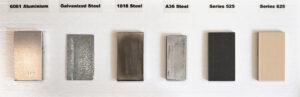
Before
With a 5% NaCl salt solution spray test, unprotected carbon steels such as 1018 and A36 develop red rust within 4 days, demonstrating their vulnerability to corrosion. Galvanized steel provides improved performance by protecting the underlying steel with a sacrificial zinc coating, while 6061 aluminum resists rust through its natural oxide layer but can experience pitting when exposed to chlorides over time.
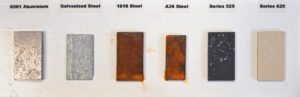
4 Days
Strongwell’s Fiber-Reinforced Polymer (FRP) offers a fundamentally different approach. Because FRP is inherently corrosion resistant, it does not rust or pit like metallic materials. During salt spray exposure, quality structural FRP retains its structural properties with only minor cosmetic changes, making it well suited for demanding service environments.
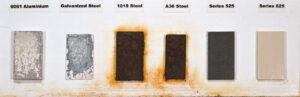
7 Months
For decades, Strongwell pultruded FRP products have delivered reliable performance in wastewater treatment facilities, marine structures, chemical processing plants, cooling towers, and other corrosive applications. By eliminating concerns associated with rust and reducing the need for protective coatings and ongoing maintenance, FRP helps owners lower lifecycle costs while improving long-term reliability.
When selecting materials for corrosive environments, performance should be measured over the life of the structure—not just at installation. Salt solution spray testing reinforces what decades of field experience have demonstrated: FRP is a durable, low-maintenance solution engineered to withstand many of the world's most challenging environments.
You must be logged in to post a comment.